
Ghosts, Legends, and Libby Custer
Inside Mandan’s Haunted Fort
October 2026
Each October, a little chill creeps into the air at Fort Abraham Lincoln State Park, and it’s not just the North Dakota weather. For 24 years, the historic fort, just south of Mandan, has transformed into one of the region’s most beloved Halloween traditions: the Haunted Fort. But long before the actors, fog machines, and laser swamps arrived, the fort already had a reputation for being a little bit haunted, and Matt Schanandore has heard just about every story there is to tell.
Schanandore is the Executive Director of the Mandan Progress Organization (MPO), but he spent years as Interpretive and Events Coordinator at the state park, where he collected decades of tales passed down by staff, reenactors, and visitors alike.
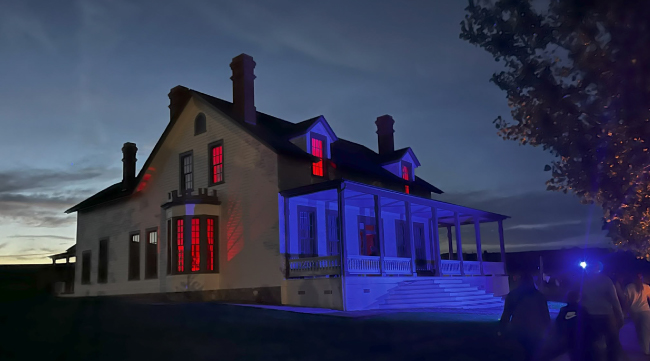
The fort’s ghost stories began with a name most North Dakotans know well: Lieutenant Colonel George Armstrong Custer. Custer and his wife, Elizabeth “Libby” Custer, lived in the home now known as the Custer House, and Schanandore says the stories tied to that home have been told for more than a century. In 1876, Custer left the fort for what would become the Battle of the Little Bighorn, but he never came home. “Libby remained at the fort, and through the decades, romanticized legends of a devoted wife waiting for her true love’s return became a favorite story around Bismarck-Mandan campfires,” says Schanandore.
Here’s the twist: According to Schanandore, the Custer House that stands today, along with the fort’s other buildings, is a reconstruction - not the original structure. You might expect that to put a damper on ghost stories, but according to Schanandore, it did the opposite. “Stories of unexplained activity began almost as soon as reconstruction started,” he says. “Workers on the project were reporting things they couldn’t explain — tools moving on their own, objects falling for no reason, sounds with no sources.”
Once the Custer House, granary, soldier barracks, and commissary were completed, fort reenactors began reporting similar experiences. “Some who stayed overnight in the soldier barracks described hearing distinct footsteps on the wooden porch, and being familiar with 19th-century military uniforms and boot construction, they were confident the sound couldn’t have come from modern footwear,” says Schanandore.
What Schanandore finds most compelling, though, is that this isn’t a purely modern phenomenon. Historical records show that soldiers stationed at Fort Lincoln in the mid-to-late 1800s reported paranormal experiences of their own. One local newspaper from that era even reported that a medium was brought to the fort to investigate unexplained activity. Blend those century-old accounts with modern-day stories, and it’s easy to see why many consider the fort the most haunted place in North Dakota.
Interest in the fort’s haunted reputation surged again in the early 2000s, as paranormal investigation programs and podcasts became part of the pop culture landscape. Schanandore says that renewed fascination, and a community’s love of a good scare, is exactly what led to the creation of the Haunted Fort. “People like experiencing things together as a community, and we’re always going to encourage that,” he says. “Kids and adults love the adrenaline rush and experiencing something thrilling together.” He says it’s common to see participants of the Haunted Fort screaming and yelling together as a group, followed by lots of laughing.
Behind every scream is a dedicated team that Schanandore doesn’t take for granted. “It takes a lot of very unique and passionate people to make the Haunted Fort what it is,” he says. “The actors are what I would consider to be Halloween enthusiasts. He says there’s a very strong return of staff each year. There’s a team that designs and builds out the sets in each building, but “it’s the many actors who really create the whole thing,” he says. And that team comes from all walks of life. “Our team comes from all various industries outside of spooking — librarians, county and state employees, auto techs — a huge spectrum of people who love being in that moment of creating a unique experience for people.”
Fort Lincoln remains one of the MPO’s signature partners, playing a central role in the “Visit Mandan” marketing plan that promotes events and attractions throughout the Mandan-Morton County area. This year marks the Haunted Fort’s 24th season, and it shows no signs of slowing down.
The event kicks off with “Spookless Nights” on October 2-3, a toned-down experience designed for younger kids whose parents aren’t quite ready to find out if their children can handle the full scare. Kids still tour the Custer House and other buildings, but without anything jumping out at them.
All other Friday and Saturday nights after that and through Halloween, belong to the full Haunted Fort experience. Brave guests walk through four buildings, including the Custer House, navigating the dark alongside scary music, mazes, and laser swamps, with a chance to encounter Libby Custer’s legend or hear the footsteps of soldiers long gone. Actors bring the scares, but they never touch the guests.
Tickets are sold online in advance by time slot, so visitors can skip the line and avoid the risk of a sellout.
Proceeds from the Haunted Fort support both North Dakota’s state parks and the MPO, a partnership Schanandore sees as central to the event’s staying power. “It’s not something you normally see,” he says, “two organizations, both state and nonprofit, working together to support something the people love.”
For more information or to purchase tickets, check out the Haunted Fort online or visit their Facebook page.
More stories in this Issue

BEK TV Brings Home 3 Wins This Year
October 2026

Message from the CEO
October 2026
Behind the Board
October 2026
Ghosts, Legends, and Libby Custer
October 2026

75 Years, Five Ways to Celebrate!
October 2026

October is Cybersecurity Awareness Month
October 2026

A Seasonal Reminder
October 2026

Click Smart – Stay Cyber Safe
October 2026
